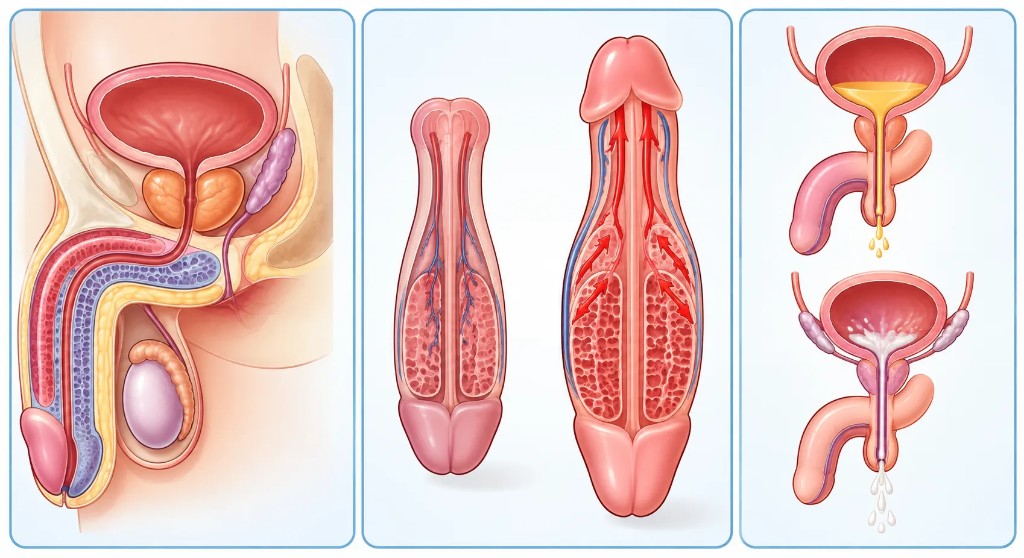
The penis is an external organ that forms part of the male reproductive and urinary systems, serving two distinct functions: the passage of urine and a role in reproduction.
Structure
The penis is made up of specialized tissue, including two parallel columns of erectile tissue running along its length, along with a third column that surrounds the urethra, the tube that carries both urine and semen. This erectile tissue is made up of a spongy network capable of filling with blood under certain conditions.
The Process of Erection
During sexual arousal, nerve signals trigger the blood vessels supplying the erectile tissue to widen considerably, allowing a significant increase in blood flow into this spongy tissue. As the tissue fills with blood, it expands and becomes firm, while a valve-like mechanism temporarily restricts blood from draining back out at the same rate, maintaining firmness. This combination of increased inflow and restricted outflow produces an erection.
Its Role in Urination
Outside of sexual function, the penis serves as the external outlet for urine, which travels from the bladder through the urethra and out through an opening at the tip of the penis, a process controlled by the same muscular valves that regulate bladder emptying more broadly.
Its Role in Reproduction
During ejaculation, semen, containing sperm along with fluid from the prostate and other glands, travels through the urethra and is expelled from the body, delivering sperm as part of the reproductive process.
Background
Basic anatomical understanding of the penis has existed since ancient medical traditions, but a detailed physiological understanding of the erection process, particularly the specific role of blood flow and the vascular mechanisms involved, was established more thoroughly through research conducted in the 20th century. This research clarified the coordinated relationship between nerve signals and blood vessel function that underlies erection, refining what had previously been a more limited anatomical understanding of the structure.