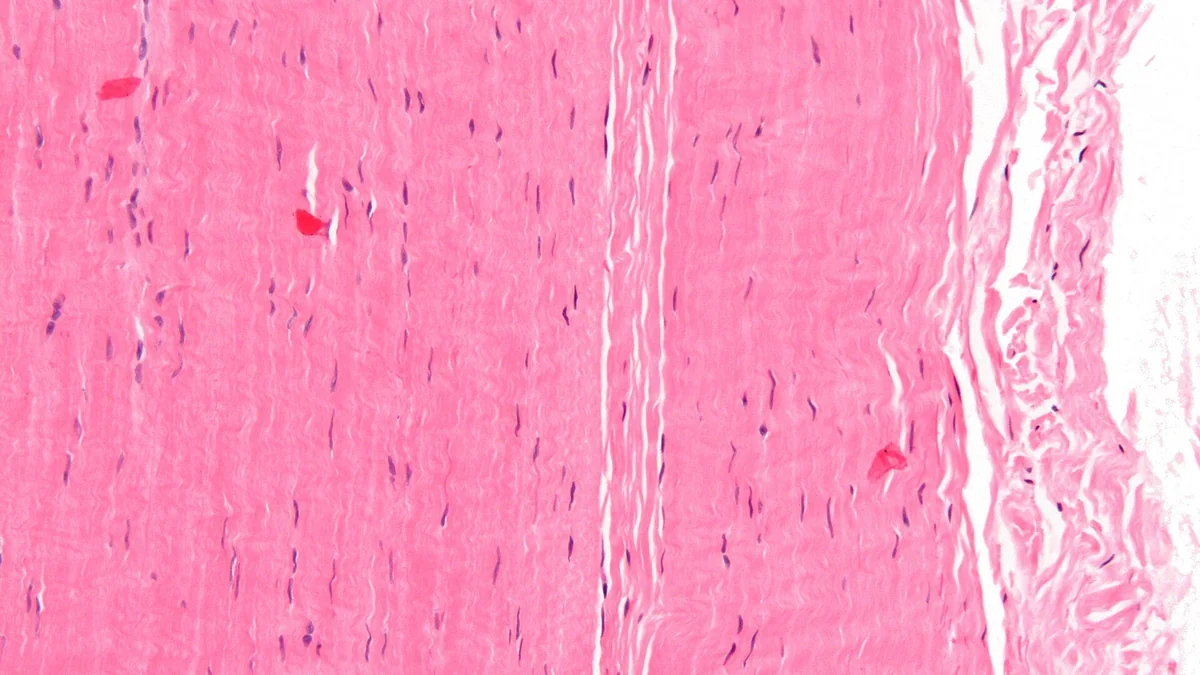
Tendons and ligaments are both made of tough, fibrous connective tissue, and while they're often mentioned together, they serve distinct roles in how the body moves and stays structurally stable.
Tendons: Connecting Muscle to Bone
Tendons connect muscles to bones, acting as the mechanical link that transmits the force generated by a contracting muscle into movement of the bone it's attached to. When a muscle contracts, it pulls on the tendon, which in turn pulls on the bone, producing motion at a joint. Tendons are built primarily from a protein called collagen, arranged in dense, parallel fibers that give them considerable strength along their length while still allowing some flexibility.
Ligaments: Connecting Bone to Bone
Ligaments, by contrast, connect one bone directly to another bone, typically at or around a joint. Their main role is to stabilize joints, holding bones in proper alignment and limiting how far a joint can move in certain directions, which helps prevent excessive or abnormal motion that could otherwise lead to injury.
Built for Their Specific Jobs
Both tissues are made of similarly structured collagen fibers, but they're organized somewhat differently to suit their distinct roles. Tendons are generally built to withstand strong, repeated pulling forces along a single direction, matching the pulling action of the muscle they're attached to. Ligaments are often arranged to resist forces from multiple directions, reflecting their role in keeping a joint stable across a range of movements.
Limited Blood Supply
Both tendons and ligaments generally have a more limited blood supply compared to muscle tissue, which is part of why injuries to these structures often take longer to heal than muscle injuries.
Background
The distinction between tendons and ligaments, along with a clearer understanding of collagen as their primary structural protein, developed through anatomical and biochemical research over the 19th and 20th centuries. This research clarified how these two types of connective tissue, though similar in composition, are specifically structured to serve their different mechanical roles within the body's joints and muscles.