
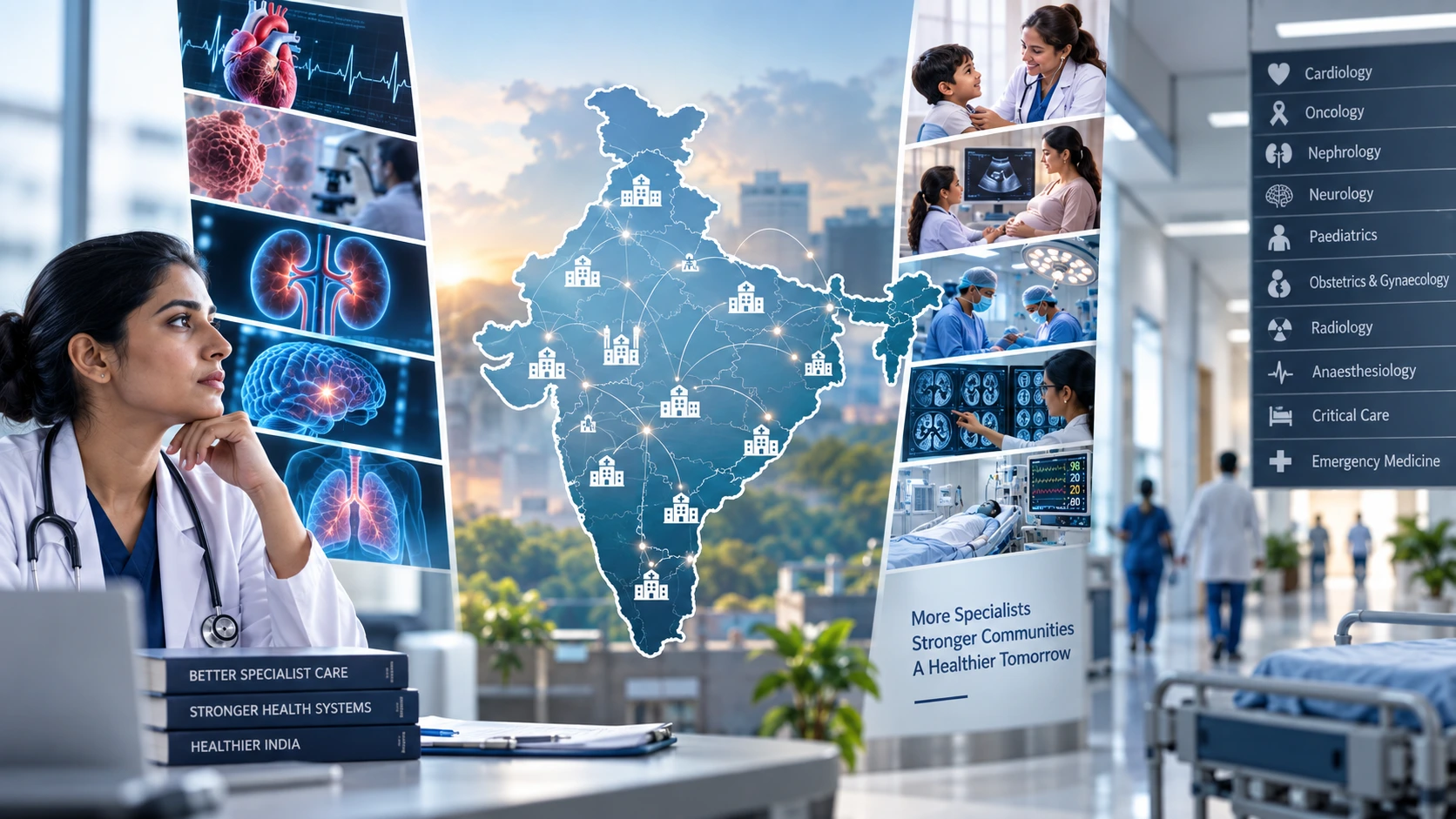
India has a lot of doctors on paper. Around 13 lakh allopathic doctors were registered with state medical councils and the National Medical Commission as of June 2022. Estimates of the shortfall vary. One industry estimate puts practising doctors at about 10 lakh, or one active MBBS doctor per 1,343 people, with only 0.3 specialists per 1,000 population. The government's own ratio, which includes AYUSH practitioners, looks much better. The clearest shortage is in specialists, not in general doctors.
The specialist gap
In rural health data from a few years ago, only about 6% of primary health centres had no doctor, yet roughly 82% of specialist posts (surgeons, physicians, paediatricians, obstetrician-gynaecologists) at community level were unfilled. Demand is highest where patient need is large and trained people are few.
Specialties in highest demand
**Cardiology.** Heart disease is one of the country's biggest killers. Clinicians told lawmakers that India had about 4,000 cardiologists against a requirement of 88,000, with only 315 postgraduate seats where 3,375 were needed. These figures are older, but the direction has not changed. Interventional cardiology and cardiac surgery are especially scarce.
**Oncology.** Cancer is a leading cause of adult mortality, with millions of patients at any time and roughly a million new diagnoses a year, against a very small oncologist workforce by international comparison. Medical, surgical and radiation oncologists are all needed, particularly outside the metros.
**Nephrology, neurology and pulmonology.** Specialists say the shortage of pulmonologists, neurologists, nephrologists, paediatricians and general surgeons is too large to close quickly. On nephrology specifically, the older estimate was about 1,200 practising nephrologists against a need of 40,000.
**Paediatrics, obstetrics and gynaecology, general medicine and general surgery.** These are the backbone of district hospitals. They matter because specialists are the ones who can bring down infant and maternal mortality to meet international targets.
**Anaesthesiology, radiology, critical care and emergency medicine.** Growth in hospital infrastructure drives demand here. Cardiology, emergency medicine, radiology, critical care, oncology, endocrinology and nephrology are among the most in-demand fields. Anaesthesiologists are needed well beyond the operating theatre: in ICUs, emergency departments, pain clinics and trauma units.
**Endocrinology and lifestyle-disease care.** Cardiovascular and neurological disorders, cancer and diabetes now form a large share of the disease burden, and they need long-term specialist follow-up that an MBBS doctor alone cannot provide.
Emerging areas
Some newer fields are expected to grow quickly. Interventional radiology, fetal medicine, pain medicine, critical care, emergency medicine and aesthetic medicine are seen as growth areas as healthcare becomes more technology-driven. AI is more likely to support specialists than replace them, especially in radiology, pathology, cardiology and oncology.
Demand versus popularity
Two things get confused here: what the health system needs and what medical graduates want. Top NEET-PG rankers tend to go for radiology, dermatology, orthopaedics, ophthalmology and anaesthesia. Those are competitive, but they are not always where the public-health shortage is worst. Some of the biggest shortages, such as nephrology, oncology and paediatrics, are in fields with far fewer seats than the need.
Why the gap persists
**Too few PG seats.** Medical colleges offer very few postgraduate seats, which limits how many specialists are trained.
**Uneven distribution.** Reluctance to work in rural areas adds to the scarcity.
**Under-used training capacity.** More than 1,000 accredited hospitals already contribute around 12,000 DNB, DrNB and FNB seats, and mid-sized hospitals could add more.
For doctors, this means that many tier 2 and tier 3 cities may offer higher pay than metros because specialists are so scarce.
The takeaway
Cardiology, oncology, nephrology, neurology, paediatrics, obstetrics and gynaecology, anaesthesia, radiology and critical care are the specialties with the strongest, most durable demand. Several of the headline numbers above come from older reports, so anyone using this for career planning or publication should check the latest NMC and Health Ministry data.
References
- Parliament of India — Lok Sabha / Rajya Sabha health workforce discussions ([eparlib.india.gov.in](https://eparlib.india.gov.in/))
- NATHEALTH — industry workforce estimates ([nathealthindia.org](https://nathealthindia.org/))
- The Ken — rural specialist vacancy reporting ([the-ken.com](https://the-ken.com/))
- Deccan Herald — specialist shortage coverage ([deccanherald.com](https://www.deccanherald.com/))
- National Medical Commission — registration and PG seat statistics ([nmc.org.in](https://www.nmc.org.in/))